Loading this medicine

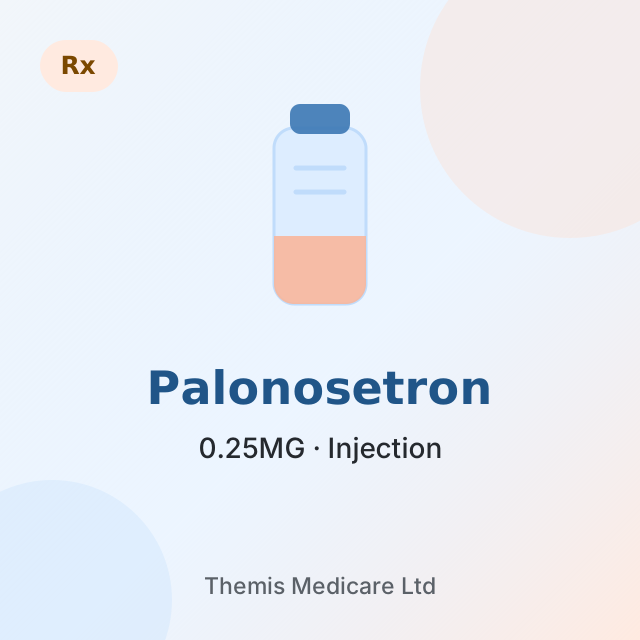
Illustration only
by Themis Medicare Ltd
Palonosetron 0.25MG Injection
₹247.44
0.25MG · 1 VIAL(s) OF 5ML
Inclusive of all taxes
Delivery calculated at checkout
Upload your prescription after ordering. Your order is confirmed after pharmacist approval.
Cancelled if no prescription is received within 72 hours. Nothing charged before delivery.
Palonosetron injection is indicated in adults for prevention of: - acute and delayed nausea and vomiting associated with initial and repeat courses of moderately emetogenic cancer chemotherapy (MEC). - acute nausea and vomiting associated with initial and repeat courses of highly emetogenic cancer chemotherapy (HEC). - postoperative nausea and vomiting (PONV) for up to 24 hours following surgery. Efficacy beyond 24 hours has not been demonstrated. As with other antiemetics, routine prophylaxis is not recommended in patients in whom there is little expectation that nausea and/or vomiting will occur postoperatively. In patients where nausea and vomiting must be avoided during the postoperative period, Palonosetron is recommended even where the incidence of postoperative nausea and/or vomiting is low. Palonosetron injection is indicated in pediatric patients 1 month to less than 17 years of age for prevention of: - acute nausea and vomiting associated with initial and repeat courses of emetogenic cancer chemotherapy, including highly emetogenic cancer chemotherapy. Palonosetron is a serotonin-3 (5-HT 3 ) receptor antagonist indicated in: Adults for prevention of: - acute and delayed nausea and vomiting associated with initial and repeat courses of moderately emetogenic cancer chemotherapy (MEC). Pediatric patients aged 1 month to less than 17 years for prevention of: - acute nausea and vomiting associated with initial and repeat courses of emetogenic cancer chemotherapy, including highly emetogenic cancer chemotherapy (HEC).
Source: US FDA prescribing information, via openFDA. Provided for general information only — it is not a substitute for your doctor's or pharmacist's advice. Always follow your prescriber's instructions.
Source: US FDA prescribing information, via openFDA. Provided for general information only — it is not a substitute for your doctor's or pharmacist's advice. Always follow your prescriber's instructions.
Serious or otherwise clinically significant adverse reactions reported in other sections of labeling: - Hypersensitivity Reactions - Serotonin Syndrome Most common adverse reactions in - chemotherapy-induced nausea and vomiting in adults (≥ 5%) are: headache and constipation. - postoperative nausea and vomiting (≥ 2%) are: QT prolongation, bradycardia, headache, and constipation. Clinical Trials Experience Because clinical trials are conducted under widely varying conditions, adverse reaction rates observed in the clinical trials of a drug cannot be directly compared to rates in the clinical trials of another drug and may not reflect the rates observed in practice. Chemotherapy-Induced Nausea and Vomiting Adults In double-blind randomized clinical trials for the prevention of nausea and vomiting induced by MEC or HEC, 1374 adult patients received a single dose of Palonosetron injection, ondansetron (Studies 1 and 3) or dolasetron (Study 2) administered 30 minutes prior to chemotherapy. Adverse reactions were similar in frequency and severity in all 3 treatment groups. Common adverse reactions reported in at least 2% of patients in these trials are shown in Table 2. Table 2: Common Adverse Reactions Reported in at least 2% of patients in any treatment group in Adults with Receiving MEC (Studies 1 and 2) or HEC (Study 3) Adverse Reaction Palonosetron Injection 0.25 mg intravenously (N = 633) Ondansetron 32 mg intravenously (N = 410) Dolasetron 100 mg intravenously (N = 194) Headache 9% 8% 16% Constipation 5% 2% 6% Diarrhea 1% 2% 2% Dizziness 1% 2% 2% Fatigue < 1% 1% 2% Abdominal Pain < 1% < 1% 2% Insomnia < 1% 1% 2% Less common adverse reactions, reported in 1% or less of patients, in Studies 1, 2 and 3 were: - Cardiovascular: non-sustained tachycardia, bradycardia, hypotension, hypertension, myocardial ischemia, extrasystoles, sinus tachycardia, sinus arrhythmia, supraventricular extrasystoles and QT prolongation - Dermatological: allergic dermatitis, rash - Hearing and Vision: motion sickness, tinnitus, eye irritation and amblyopia - Gastrointestinal System: diarrhea, dyspepsia, abdominal pain, dry mouth, hiccups and flatulence - General: weakness, fatigue, fever, hot flash, flu-like syndrome - Liver: transient, asymptomatic increases in AST and/or ALT and bilirubin. Abridged from the full prescribing information.
Source: US FDA prescribing information, via openFDA. Provided for general information only — it is not a substitute for your doctor's or pharmacist's advice. Always follow your prescriber's instructions.