Loading this medicine

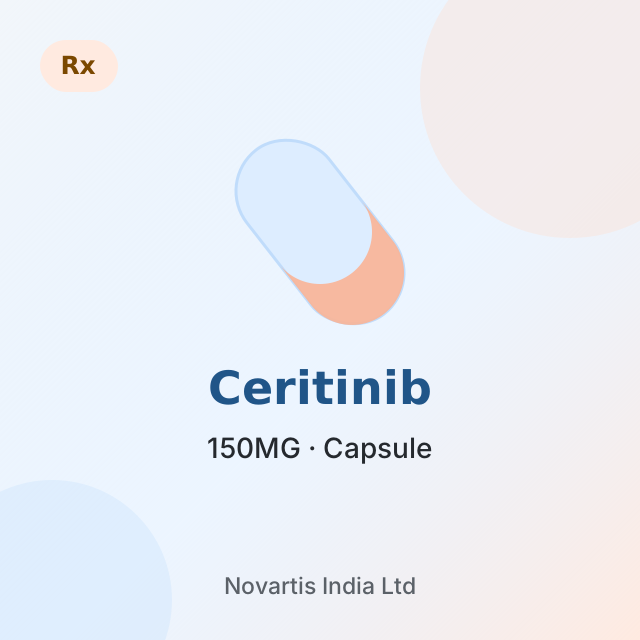
Illustration only
by Novartis India Ltd
Ceritinib 150MG Capsule
₹5,662.50
150MG · 10 CAPSULE(s) IN A STRIP
Inclusive of all taxes
Delivery calculated at checkout
Upload your prescription after ordering. Your order is confirmed after pharmacist approval.
Cancelled if no prescription is received within 72 hours. Nothing charged before delivery.
Ceritinib ® is indicated for the treatment of adult patients with metastatic non-small cell lung cancer (NSCLC) whose tumors are anaplastic lymphoma kinase (ALK)-positive as detected by an FDA-approved test. Ceritinib is a kinase inhibitor indicated for the treatment of adults with metastatic non-small cell lung cancer (NSCLC) whose tumors are anaplastic lymphoma kinase (ALK)-positive as detected by an FDA-approved test.
Source: US FDA prescribing information, via openFDA. Provided for general information only — it is not a substitute for your doctor's or pharmacist's advice. Always follow your prescriber's instructions.
Gastrointestinal Adverse Reactions: Ceritinib can cause gastrointestinal adverse reactions. If severe or intolerable, withhold if not responsive to antiemetics or antidiarrheals; upon improvement, resume Ceritinib at a reduced dose. Hepatotoxicity: Ceritinib can cause hepatotoxicity. Monitor liver laboratory tests at least monthly. Withhold then dose reduce, or permanently discontinue Ceritinib. Interstitial Lung Disease/Pneumonitis: Occurred in 2.4% of patients. Permanently discontinue Ceritinib in patients diagnosed with treatment-related interstitial lung disease (ILD)/pneumonitis. QT Interval Prolongation: Ceritinib can cause QTc interval prolongation. Monitor electrocardiograms and electrolytes in patients with congestive heart failure, bradyarrhythmias, electrolyte abnormalities, or those who are taking medications that are known to prolong the QTc interval. Hyperglycemia: Ceritinib can cause hyperglycemia. Monitor fasting glucose prior to treatment and periodically thereafter. Initiate or optimize anti-hyperglycemic medications as indicated. Bradycardia: Ceritinib can cause bradycardia. Monitor heart rate and blood pressure regularly. Pancreatitis: Elevations of lipase and/or amylase and pancreatitis can occur. Monitor lipase and amylase prior to treatment and periodically thereafter as clinically indicated. Withhold, then dose reduce Ceritinib. Embryo-Fetal Toxicity: Ceritinib can cause fetal harm. Advise females of reproductive potential of the potential risk to a fetus and to use effective contraception. Gastrointestinal Adverse Reactions Severe gastrointestinal adverse reactions occurred in patients treated with Ceritinib 750 mg under fasted conditions. Diarrhea, nausea, vomiting, or abdominal pain occurred in 95% of 925 patients, including severe cases (Grade 3 or 4) in 14% of patients treated with Ceritinib across clinical studies. Diarrhea, nausea, vomiting, or abdominal pain leading to dose interruptions or reductions occurred in 36% of patients and leading to treatment discontinuation occurred in 1.6% of patients. The incidence and severity of gastrointestinal adverse reactions were reduced for patients treated with Ceritinib 450 mg with food in a dose optimization study (ASCEND-8). Diarrhea, nausea, vomiting, or abdominal pain occurred in 79% of 108 patients treated with Ceritinib at the recommended dose of 450 mg with food. Of these, 53% were Grade 1 events and 24% were Grade 2 events. One patient (0.9%) experienced Grade 3 diarrhea, and one patient (0.9%) experienced Grade 3 vomiting. One patient (0.9%) required dose adjustment due to vomiting. Eleven (10%) patients had diarrhea, nausea, vomiting, or abdominal pain that required at least one dose interruption. Abridged from the full prescribing information.
Source: US FDA prescribing information, via openFDA. Provided for general information only — it is not a substitute for your doctor's or pharmacist's advice. Always follow your prescriber's instructions.
The following clinically significant adverse reactions are described elsewhere in the labeling: Gastrointestinal Adverse Reactions Hepatotoxicity Interstitial Lung Disease/Pneumonitis QT Interval Prolongation Hyperglycemia Bradycardia Pancreatitis The most common adverse reactions (incidence of ≥ 25%) in patients treated with Ceritinib 450 mg with food are diarrhea, nausea, abdominal pain, vomiting, and fatigue; and with Ceritinib 750 mg under fasted conditions are diarrhea, nausea, vomiting, fatigue, abdominal pain, decreased appetite, and weight loss. Clinical Trials Experience Because clinical trials are conducted under widely varying conditions, adverse reaction rates observed in the clinical trials of a drug cannot be directly compared to rates in the clinical trials of another drug and may not reflect the rates observed in practice. The data in the Warnings and Precautions section reflect exposure to Ceritinib 750 mg once daily under fasted conditions in 925 patients with ALK-positive NSCLC across seven clinical studies, including ASCEND-4 and ASCEND-1, described below, a randomized active-controlled study, two single arm studies, and two dose-escalation studies. The majority of patients enrolled in these studies had received prior treatment with chemotherapy and/or crizotinib for NSCLC. Among these 925 patients, the most common adverse reactions (≥ 25% incidence) were diarrhea, nausea, vomiting, fatigue, abdominal pain, decreased appetite, and weight loss. Approximately 45% of patients initiating treatment with Ceritinib 750 mg under fasted conditions had an adverse reaction that required at least one dose reduction and 66% of patients had an adverse reaction that required at least one dose interruption. The median time to first dose reduction due to any reason was 7 weeks. Dose Optimization Study: Dosing Regimen of 450 mg Daily With Food In ASCEND-8, a dose optimization study, Ceritinib 450 mg daily with food (N = 108) was compared to 750 mg daily under fasted conditions (N = 110) in both previously treated and untreated patients with ALK-positive NSCLC. The overall safety profile of Ceritinib 450 mg with food was consistent with Ceritinib 750 mg fasted, except for a reduction in gastrointestinal adverse reactions, while achieving comparable steady-state exposure. The most common adverse reactions (≥ 25% incidence) in the 450 mg with food arm were diarrhea, nausea, abdominal pain, vomiting, and fatigue. Abridged from the full prescribing information.
Source: US FDA prescribing information, via openFDA. Provided for general information only — it is not a substitute for your doctor's or pharmacist's advice. Always follow your prescriber's instructions.
Targeted Therapy & Kinase Inhibitors
250MG
₹9,244.13
View medicine
Targeted Therapy & Kinase Inhibitors
100MG
₹14,531.25
View medicine
Targeted Therapy & Kinase Inhibitors
100MG
₹14,531.25
View medicine
Targeted Therapy & Kinase Inhibitors
100MG
₹12,281
View medicine