Loading this medicine

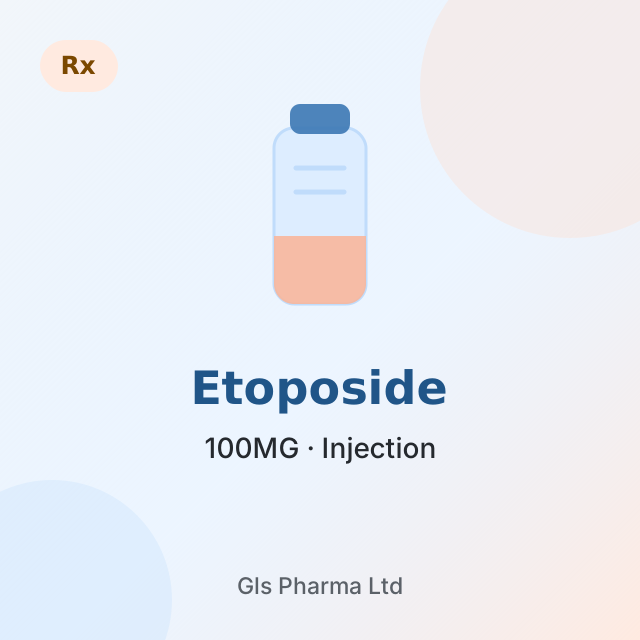
Illustration only
by Gls Pharma Ltd
Etoposide 100MG Injection
₹180
100MG · 1 VIAL(s) OF 5ML
Inclusive of all taxes
Delivery calculated at checkout
Upload your prescription after ordering. Your order is confirmed after pharmacist approval.
Cancelled if no prescription is received within 72 hours. Nothing charged before delivery.
Etoposide Injection is indicated in the management of the following neoplasms: Refractory Testicular Tumors Etoposide Injection in combination therapy with other approved chemotherapeutic agents in patients with refractory testicular tumors who have already received appropriate surgical, chemotherapeutic, and radiotherapeutic therapy. Small Cell Lung Cancer Etoposide Injection and/or capsules in combination with other approved chemotherapeutic agents as first line treatment in patients with small cell lung cancer.
Source: US FDA prescribing information, via openFDA. Provided for general information only — it is not a substitute for your doctor's or pharmacist's advice. Always follow your prescriber's instructions.
Boxed warning. Etoposide injection should be administered under the supervision of a qualified physician experienced in the use of cancer chemotherapeutic agents. Severe myelosuppression with resulting infection or bleeding may occur. Patients being treated with Etoposide injection must be frequently observed for myelosuppression both during and after therapy. Myelosuppression resulting in death has been reported. Dose-limiting bone marrow suppression is the most significant toxicity associated with Etoposide injection therapy. Therefore, the following studies should be obtained at the start of therapy and prior to each subsequent cycle of Etoposide injection: platelet count, hemoglobin, white blood cell count, and differential. The occurrence of a platelet count below 50,000/mm 3 or an absolute neutrophil count below 500/mm 3 is an indication to withhold further therapy until the blood counts have sufficiently recovered. Physicians should be aware of the possible occurrence of an anaphylactic reaction manifested by chills, fever, tachycardia, bronchospasm, dyspnea, and hypotension. Higher rates of anaphylactic-like reactions have been reported in children who received infusions at concentrations higher than those recommended. The role that concentration of infusion (or rate of infusion) plays in the development of anaphylactic-like reactions is uncertain (see ADVERSE REACTIONS section). Treatment is symptomatic. The infusion should be terminated immediately, followed by the administration of pressor agents, corticosteroids, antihistamines, or volume expanders at the discretion of the physician. For parenteral administration, Etoposide injection should be given only by slow intravenous infusion (usually over a 30- to 60-minute period) since hypotension has been reported as a possible side effect of rapid intravenous injection. Pregnancy Etoposide Injection can cause fetal harm when administered to a pregnant woman. Etoposide has been shown to be teratogenic in mice and rats. In rats, an intravenous Etoposide dose of 0.4 mg/kg/day (about 1/20 th of the human dose on a mg/m 2 basis) during organogenesis caused maternal toxicity, embryotoxicity, and teratogenicity (skeletal abnormalities, exencephaly, encephalocele, and anophthalmia); higher doses of 1.2 and 3.6 mg/kg/day (about 1/7 th and 1/2 of human dose on a mg/m 2 basis) resulted in 90 and 100% embryonic resorptions. In mice, a single 1 mg/kg (1/16 th of human dose on a mg/m 2 basis) dose of Etoposide administered intraperitoneally on days 6, 7, or 8 of gestation caused embryotoxicity, cranial abnormalities, and major skeletal malformations. An I.P. Abridged from the full prescribing information.
Source: US FDA prescribing information, via openFDA. Provided for general information only — it is not a substitute for your doctor's or pharmacist's advice. Always follow your prescriber's instructions.
The following data on adverse reactions are based on both oral and intravenous administration of Etoposide injection as a single agent, using several different dose schedules for treatment of a wide variety of malignancies. Hematologic Toxicity Myelosuppression is dose related and dose limiting, with granulocyte nadirs occurring 7 to 14 days after drug administration and platelet nadirs occurring 9 to 16 days after drug administration. Bone marrow recovery is usually complete by day 20, and no cumulative toxicity has been reported. Fever and infection have also been reported in patients with neutropenia. Death associated with myelosuppression has been reported. The occurrence of acute leukemia with or without a preleukemic phase has been reported rarely in patients treated with Etoposide injection in association with other antineoplastic agents (see WARNINGS section). Gastrointestinal Toxicity Nausea and vomiting are the major gastrointestinal toxicities. The severity of such nausea and vomiting is generally mild to moderate with treatment discontinuation required in 1% of patients. Nausea and vomiting can usually be controlled with standard antiemetic therapy. Mild to severe mucositis/esophagitis may occur. Gastrointestinal toxicities are slightly more frequent after oral administration than after intravenous infusion. Hypotension Transient hypotension following rapid intravenous administration has been reported in 1% to 2% of patients. It has not been associated with cardiac toxicity or electrocardiographic changes. No delayed hypotension has been noted. To prevent this rare occurrence, it is recommended that Etoposide injection be administered by slow intravenous infusion over a 30- to 60-minute period. If hypotension occurs, it usually responds to cessation of the infusion and administration of fluids or other supportive therapy as appropriate. When restarting the infusion, a slower administration rate should be used. Allergic Reactions Anaphylactic-like reactions characterized by chills, fever, tachycardia, bronchospasm, dyspnea, and/or hypotension have been reported to occur in 0.7% to 2% of patients receiving intravenous Etoposide injection and in less than 1% of the patients treated with the oral capsules. These reactions have usually responded promptly to the cessation of the infusion and administration of pressor agents, corticosteroids, antihistamines, or volume expanders as appropriate; however, the reactions can be fatal. Hypertension and/or flushing have also been reported. Abridged from the full prescribing information.
Source: US FDA prescribing information, via openFDA. Provided for general information only — it is not a substitute for your doctor's or pharmacist's advice. Always follow your prescriber's instructions.